
Cash Flow
The 13-Week Cash Flow Forecast Every Contractor Needs

Cash flow kills more contractors than bad work. Here’s the simple 13-week rolling forecast framework that gives you complete visibility into what’s coming in, what’s going out, and whether your business survives the next quarter.
The Contractor Who Did Great Work and Still Went Broke
On a chilly Monday morning, Mark, a mid-sized general contractor, walked into his bank thinking he was there to pick up a cashier’s check. Instead, he walked out with a knot in his stomach and a hard truth ringing in his ears: “Your account is overdrawn.”
This was the same Mark whose crews were booked solid, whose projects passed inspections, whose clients loved the finished work. His reputation was spotless. His cash flow, however, was a slow-motion train wreck. Subcontractors needed to be paid on Friday, payroll hit every other week, and a supplier had just put him on hold because of a late payment. Meanwhile, two big progress payments were “on the architect’s desk” and “awaiting approval.”
Mark didn’t go under because he did bad work. He went under because he couldn’t see his money clearly enough, early enough. His story is painfully common in contractor finance: cash flow kills more contractors than bad work ever will.
💡 Pro Tip: In construction, you don’t get paid for being busy. You get paid when cash actually lands in your bank account.
Why Cash Flow, Not Craftsmanship, Decides Who Survives
If you’ve been in the trades for more than a year, you’ve seen it: the contractor with great crews, shiny trucks, and impressive jobs who suddenly disappears. People whisper about lawsuits or bad workmanship, but more often than not, the real cause is simpler and quieter: they ran out of cash before the next check arrived. That’s the brutal math of cash management in this industry.
Construction is uniquely tough on cash. You front labor and materials. You wait on inspections, approvals, and retainage. You juggle multiple projects, each with its own schedule, change orders, and payment terms. Your construction budgeting might look great on paper, but your bank balance tells a different story on Thursday night before payroll hits Friday morning.
That’s why the contractors who last aren’t always the best builders. They’re the ones who build financial visibility into their week, every week. And one of the simplest, most powerful tools they use is the 13-week cash flow forecast.

The contractors who last are the ones who see cash shortfalls weeks ahead.
What Exactly Is a 13-Week Cash Flow Forecast?
Imagine you could roll out a scroll of the next 90 days and see, week by week, every dollar you expect to come in and every dollar you expect to go out. Not as a vague guess, but in a simple, structured format you update once a week. That’s your 13-week forecast—a rolling, living picture of your cash flow for the next quarter.
It’s not a fancy accounting report. It’s more like a job schedule for your money. You already think in weeks: what crews are where, which inspections are when, which pours or installs are scheduled. The 13-week cash flow forecast simply applies that same weekly rhythm to your contractor finance reality.
📌 Key Takeaway: A 13-week forecast doesn’t predict the distant future. It gives you crystal-clear visibility into the next three months, where most cash crises actually happen.
The 13-Week Rolling Forecast Framework, Step by Step
Let’s walk through the 13-week rolling forecast framework the way a seasoned contractor would explain it to a younger version of themselves. Picture a simple spreadsheet or even a sheet of graph paper. Across the top, you’ve got 13 columns—one for each week. Down the side, you list what’s coming in and what’s going out. That’s it. But the story you tell inside that grid can save your business.
1. Start with Your Beginning Cash Balance
Week one starts with a single, honest number: how much cash is in the bank today? Not what’s on invoices, not what’s “about to come in”—actual, cleared cash. That’s your starting point, your ground truth. Write it at the top of the first week’s column as “Beginning Cash.”
2. List Cash Coming In: Your Inflows
Next, for each of the 13 weeks, list every expected cash inflow. In construction, that usually means:
Progress payments on current jobs (by project name)
Final payments and retainage releases
Change orders you expect to bill and collect
Any other income (service work, small jobs, consulting, etc.)
Put each inflow in the week you realistically expect to collect it, not when you send the invoice. This is where your experience as a contractor kicks in. If you know a certain client always drags payments by a week or two, build that reality into your cash flow story.
3. List Cash Going Out: Your Outflows
Now list your cash outflows for each week. This is where most contractors get their wake-up call. Common categories include:
Payroll and payroll taxes (field and office)
Subcontractor payments by project and due date
Materials and suppliers (including any COD orders)
Equipment rentals, fuel, and maintenance
Office overhead: rent, utilities, software, insurance, phones
Debt payments: loans, lines of credit, equipment leases
Again, place each payment in the week it will actually leave your account. This is the heartbeat of cash management: matching the rhythm of money going out with the rhythm of money coming in.
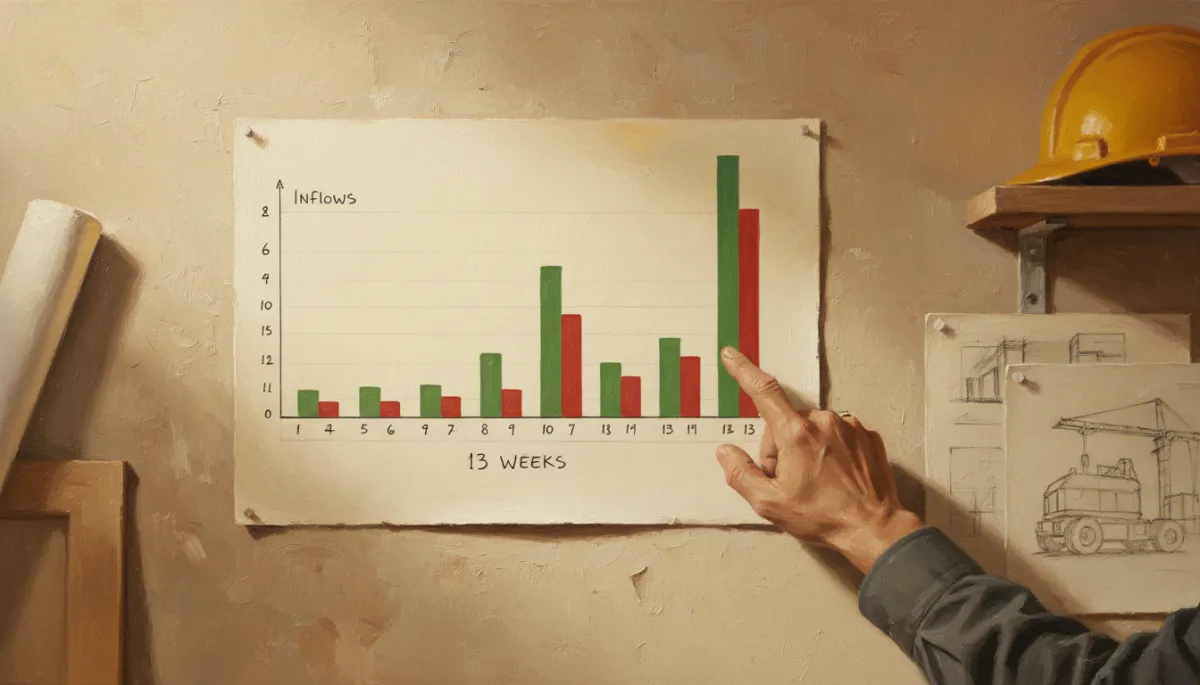
A simple weekly chart makes looming cash dips impossible to ignore.
4. Calculate Net Cash and Ending Balance Each Week
For each week, total your inflows and outflows. Subtract outflows from inflows to get your net cash for that week. Then add that net cash to your beginning balance to get your ending cash balance. That ending balance becomes next week’s beginning balance. This is what makes it a rolling 13-week forecast: every week feeds the next one.
When you do this across 13 weeks, patterns appear. You might see a comfortable cushion in weeks 1–4, then a slow bleed that turns into a cliff in week 7 when a big material bill and payroll hit before a major draw. That cliff is where contractors like Mark fall—unless they see it coming in time to build a bridge.
5. Roll It Forward Every Friday
The final piece of the framework is rhythm. Pick a day—many contractors choose Friday afternoon or Monday morning—and make it sacred. That’s when you:
Update what actually came in and went out this week
Adjust upcoming weeks based on new information (approved change orders, delayed inspections, new jobs won)
Drop the week that just passed and add a new week 13 at the end
This weekly ritual turns your 13-week forecast into a living, breathing tool—not a dusty spreadsheet. It becomes the story of your business for the next three months, updated in real time.
💡 Pro Tip: Involve your bookkeeper or office manager. They hold key details about bills and timings that make your forecast far more accurate.
How a 13-Week Forecast Gives You Complete Visibility
At first glance, the 13-week forecast looks like numbers in rows and columns. But what it really gives you is complete visibility into what’s coming in and what’s going out. That visibility changes the decisions you make long before you’re standing at the bank counter hearing the word “overdrawn.”
See Problems Early Enough to Fix Them
When you see that week 7 cliff coming on paper, you have six full weeks to respond. You can:
Push to submit and approve a progress billing earlier
Negotiate slightly different payment terms with a supplier or sub
Shift non-essential purchases or equipment upgrades into a later week
Talk to your bank about a line of credit before you desperately need it
Without this visibility, those same actions turn into panicked phone calls and last-minute scrambles. With it, they become calm, proactive moves that keep your cash flow steady and your crews working.
Align Your Construction Budgeting with Reality
Your job estimates and budgets tell you whether a project will make money on paper. Your 13-week forecast tells you whether you can afford to build it the way it’s scheduled. When you connect construction budgeting to your weekly forecast, you start asking better questions:
“If we start both of these jobs in the same month, can we float the upfront costs?”
“Does this client’s slow payment history fit our current cash position?”
“Should we schedule that big equipment purchase for quarter two instead of quarter one?”

Smart contractors plan jobs and cash side by side, not in separate silos.
Sleep Better Knowing the Next 90 Days Are Mapped
There’s another benefit that doesn’t show up in spreadsheets: peace of mind. When you can look at a simple 13-week chart and see that, barring surprises, you’ll have enough cash to cover payroll, subs, and suppliers, your shoulders drop a little. Decisions feel less like guesses and more like strategy. That calm seeps into your conversations with your team, your clients, and even your family at the dinner table.
Bringing the 13-Week Forecast into Your Business
You don’t need an MBA or a fancy software subscription to build this level of financial visibility. You just need a simple framework, a weekly habit, and the willingness to look your numbers in the eye. Here’s how contractors like you put it into practice.
Start Simple, Then Add Detail
Your first 13-week forecast doesn’t have to be perfect. In fact, it won’t be. Start with the big rocks: payroll, major supplier bills, known progress payments. As the weeks go by, you’ll naturally add more detail—separate line items by project, break out taxes, include retainage releases. The important thing is to start and to keep rolling it forward.
Make It a Standing Meeting, Not a Side Task
The contractors who get the most from this framework treat it like a jobsite meeting. Every Friday, they sit down—sometimes with their bookkeeper, sometimes with a partner—and walk through the 13 weeks. They ask, “What changed this week? What’s new? Where do we see trouble?” Over time, that meeting becomes the backbone of their contractor finance discipline.
Use It to Guide Real Decisions
A forecast that lives in a folder and never changes your behavior is just another document. The power of a 13-week forecast is in the decisions it informs. Should you hire that extra crew now, or wait a month? Can you take on that big project with slow pay terms without choking your cash? Do you need to renegotiate a payment schedule before signing?
When you can answer those questions with a clear view of your cash flow for the next 90 days, you’re no longer flying blind. You’re piloting your business with instruments that tell you what’s really happening.

Knowing your next 13 weeks of cash changes how you lead and plan.
From Surviving to Building a Stronger Business
Think back to Mark, standing at the bank counter, blindsided by an overdraft. Now picture a different scene. Same contractor, same projects, same crews. But this time, three weeks earlier, his 13-week forecast showed a red number in week 7. He circled it. He called the architect to push a payment approval. He delayed a non-essential equipment purchase. He talked to his supplier about stretching one invoice by a week. The crisis never reached the bank counter, because he saw it on paper first.
That’s the quiet power of the 13-week cash flow forecast every contractor needs. It doesn’t just keep you out of trouble. Over time, it helps you:
Build reserves so one slow-paying client can’t sink you
Take on better projects with confidence in your cash management
Invest in people and equipment at the right time, not just when the bank account happens to look full
Most importantly, it shifts your story from “busy and stressed” to “in control and intentional.” You stop letting cash flow surprises dictate your weeks and start using a simple, rolling framework to guide how you grow.
Your Next Step: Write the First Line of Your Forecast
Tonight, after the jobsite dust settles, sit down at your desk. Open a blank spreadsheet or grab a clean sheet of paper. Draw 13 columns. Label them Week 1 through Week 13. At the top of Week 1, write one number: the cash in your bank account today. That’s the first line of your new story—a story where cash flow doesn’t sneak up behind you, but walks beside you, week after week, in full view.
Because in the end, it’s not just your craftsmanship that keeps your business alive. It’s your ability to see, in advance, what’s coming in and what’s going out—and to steer your company through those 13 weeks, again and again, with eyes wide open.
Numbers that finally make sense.
Tru-Financial Management gives contractors and small businesses clean books, real job costing, and tax-ready financials — all in one house.
Book a free consultation