
Job Costing
Is Job-Costing Mismanagement a Cultural Problem in Contracting?
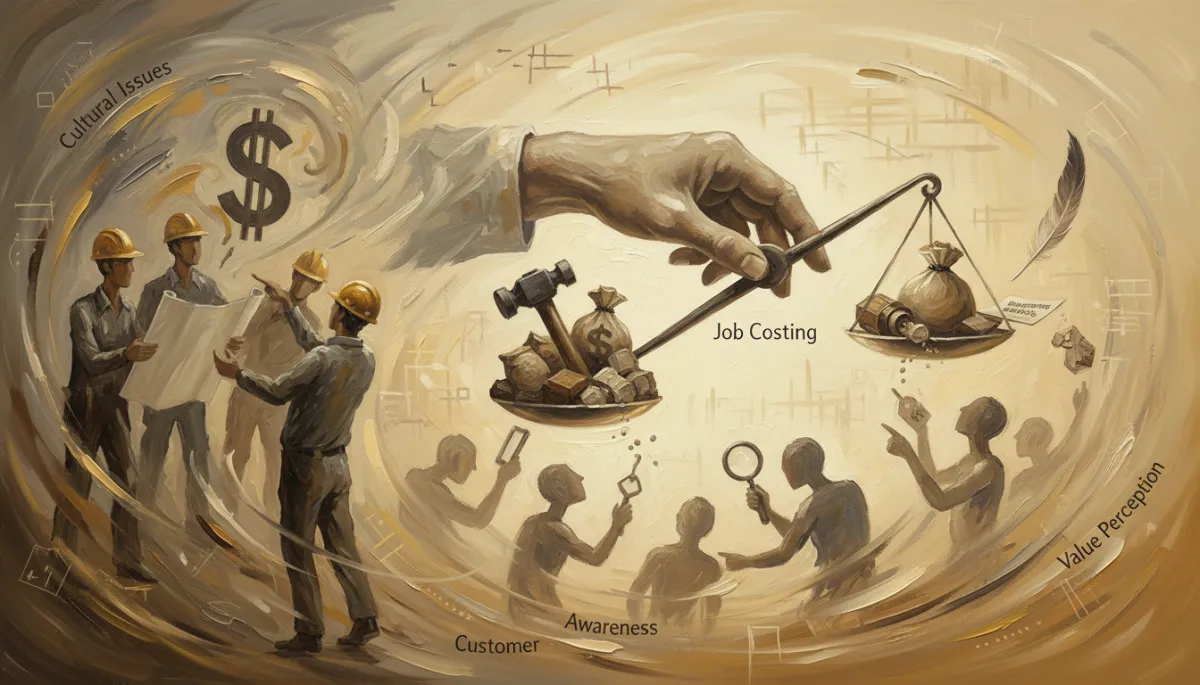
A storytelling look at why so many contractors price their work wrong, how negotiation and culture shape those decisions, and what customers really understand about the value they’re buying.
The Story of the Underpriced Kitchen
On a rainy Tuesday morning, Mark, a small remodeling contractor, sat in his truck outside a client’s house, staring at the final numbers on his latest kitchen project. The cabinets were perfect, the tile lines straight as a ruler, and the homeowner had just told him, “We love it.” Then she added the sentence he’d heard a hundred times before: “You should charge more for this kind of work.”
Mark smiled politely, but as he added up his labor, materials, overhead, and the three extra site visits that weren’t in the original scope, the truth hit him: once again, he’d priced the job too low. His Job Costing spreadsheet told one story; his bank account told another. Somewhere between his calculator and the customer’s check, money had evaporated. It wasn’t just a math issue. It felt deeper, like something baked into the way he’d been taught to do business from day one.

Many pricing mistakes are born at the kitchen table, long before work begins.
Is Job-Costing Mismanagement Really a Cultural Problem?
When you talk to contractors like Mark, you rarely hear them say, “I don’t know how to add.” They know how to total up material and hours. The deeper issue is how they’ve been trained—explicitly and silently—to think about Contractor Pricing. In many trades, there’s a quiet culture that glorifies the “sharp pencil,” the low bid, the guy who can “do it cheaper and still make it work.” Pride is tied to hustling, not to healthy margins. That’s where job-costing mismanagement becomes less of a spreadsheet problem and more of a Cultural Issue.
Apprentices listen to seasoned pros brag about how they “beat the other guys by two grand” to land a job, but rarely hear a story about carefully tracking overhead or building a sustainable profit. The story told on job sites is that toughness, not numbers, wins the day. Over time, this culture trains contractors to see accurate Job Costing as optional paperwork instead of a survival tool. Underpricing becomes normal, even honorable, as if charging what the work truly costs is somehow greedy or disloyal to the trade.
💡 Pro Tip: If telling your pricing story makes you uncomfortable, that discomfort is often a cultural inheritance, not a reflection of your actual value.
Do Negotiation Tactics Push Prices Too Low?
Back at that kitchen table, Mark remembered exactly how this job started. The homeowner had looked at his first proposal and said, “Can you do any better on the price?” It was a simple Negotiation Tactic, delivered with a friendly smile. Mark felt the old reflex kick in—shave a little off labor, trim the markup, cut his own pay first. He lowered the number because that’s what he’d always done to “win” work.
Is that why so many contractors price incorrectly? Partly. The constant pressure to negotiate lower prices absolutely contributes to bad Contractor Pricing. But the root problem isn’t the customer asking; it’s the contractor not knowing, or not trusting, their real costs. When your Job Costing is vague, every discount feels like a small concession. When your numbers are clear, every discount is a direct hit to your paycheck, your crew’s stability, and the future of your business.
In other words, negotiation doesn’t create bad pricing on its own; it exposes shaky pricing that was already there. A contractor who truly understands their costs can say, “I can adjust the scope, but I can’t do that same work for less,” without flinching. A contractor who doesn’t will keep trimming until they’re working for free and blaming the customer for “beating them up on price.”

Every signature locks in not just a price, but a story about worth and trust.
How Customers Put a Value on Contractors’ Work
On the other side of the table, the homeowner has their own story running. They’re comparing your number not just to other bids, but to their own Value Perception. Maybe their neighbor “got a whole kitchen for fifteen grand,” or they saw a TV show where a bathroom makeover happened in a weekend. Maybe they’ve never hired a contractor before and are quietly terrified of overpaying. So they do what people do in every marketplace: they test the price.
Customers put a value on your work based on what they can see and what they can imagine. They see the finished cabinets, the new roof, the fresh paint. They imagine how it will feel to live in that space, how neighbors will react, how it will affect resale. But they rarely see the insurance payments, the training, the time spent at the lumberyard, or the hours spent revising drawings at midnight. Their Value Perception is emotional first, financial second, and almost never rooted in the full reality of Job Costing.
That’s why two identical bids can be received so differently. One customer says, “That seems fair,” while another says, “That’s outrageous.” They aren’t evaluating your spreadsheet; they’re evaluating their own comfort, fear, and expectations. When contractors don’t guide that perception—by explaining what’s included, what it takes, and why it costs what it does—customers fill the gaps with guesses, and those guesses are often wrong and dangerously low.
Do Customers Really Know What It Takes?
One afternoon, after wrapping up a deck project, Mark overheard his client telling a friend on the phone, “They were here for, what, a week and a half? Not bad for the price.” Mark glanced at his time sheets and shook his head. Between planning, permitting, material runs, weather delays, and clean-up, the job had eaten nearly a month of his schedule. The client saw eleven days; he saw four weeks of his life.
Most customers don’t actually know what it takes to deliver a project. Their Customer Awareness is limited to what happens in front of them: trucks arriving, saws running, walls going up. They don’t see the pre-job estimating, the back-and-forth with suppliers, the time spent chasing inspectors, or the risk you carry if anything goes wrong. They rarely understand how overhead works, how small mistakes in Job Costing compound across the year, or how fragile many contracting businesses really are beneath the surface of busy schedules and full calendars.

The hours customers never see are often where profit is lost or saved.
This lack of Customer Awareness doesn’t make clients bad people. It simply means they’re missing information. When a homeowner asks, “Why is it so expensive?” they’re really asking, “What am I not seeing?” If contractors respond only with a lower price instead of a clearer explanation, both sides stay in the dark. The customer learns that pushing on price works. The contractor learns that explaining value doesn’t matter. And the cultural cycle of underpricing continues.
Changing the Story: From Cheap to Fair
The real shift begins when contractors start telling a different story—to themselves, their crews, and their clients. Instead of bragging about how low they went to land a job, they can start taking pride in knowing their numbers and standing by them. Instead of hiding their Job Costing process, they can lightly explain it: “Here’s what goes into this price—skilled labor, quality materials, insurance, permits, and a margin that keeps us in business to honor your warranty.”
When negotiation comes—and it will—contractors can shift from automatic discounting to thoughtful Negotiation Tactics: adjusting scope instead of slashing profit, offering phased work, or suggesting alternative materials. They can invite customers into a clearer Value Perception by explaining, calmly and confidently, what it really takes to do the job right. Over time, this educates clients and slowly rewrites the culture that says “cheapest wins” into one that says “fair and sustainable wins.”

When pricing reflects real value, both contractor and client can walk away proud.
So, What’s Really Broken?
In the end, job-costing mismanagement isn’t just a calculator error or a one-off bad bid. It’s a cultural problem rooted in how contractors are taught to see themselves, how they respond to negotiation, and how little they’re encouraged to talk openly about money and value. Negotiating lower prices isn’t the only reason most contractors don’t price correctly—but it’s the pressure point that exposes weak numbers and shaky confidence. Customers put a value on contractors’ work based on what they see and feel, not on the hidden realities of overhead, risk, and expertise. And most of them, honestly, don’t know what it really takes.
The good news is that stories can change. When contractors embrace solid Job Costing, treat Contractor Pricing as a reflection of their worth, and gently raise Customer Awareness about what’s involved, the culture begins to shift. Jobs stop feeling like a gamble and start feeling like a fair trade. And somewhere, on another rainy Tuesday, a contractor sits in their truck, looks at the final numbers, and realizes—this time—they got it right.
Numbers that finally make sense.
Tru-Financial Management gives contractors and small businesses clean books, real job costing, and tax-ready financials — all in one house.
Book a free consultation