
Financial Planning
Monthly Financial Reviews: The Habit That Changes Everything

A simple monthly ritual, a quiet hour with your numbers, and a notebook can quietly transform your money story—one page, one paycheck, one decision at a time.
The Night Emma’s Bank App Told Her the Truth
Emma didn’t think she had a money management problem. She paid her bills on time, her card always worked, and she tried not to look too closely at her balance. That felt like enough—until the Sunday night her banking app flashed a number that made her stomach drop: thirty-two dollars left, and ten days until payday. Again.
She sat at her small kitchen table, phone in one hand, half-drunk tea in the other, and realized something quietly painful: she was working too hard to feel this broke, this often. It wasn’t a single bad purchase. It was a pattern she couldn’t see clearly—because she never actually looked. That night, instead of promising herself to “just spend less,” she tried something different. She opened her laptop, pulled out a notebook, and did her first real monthly financial review.
💡 Pro Tip: Financial change rarely starts with a new app. It starts with a new habit of paying attention.
What a Monthly Financial Review Really Is (and Isn’t)
When people hear “Financial Reviews,” they imagine spreadsheets, jargon, or sitting in a stuffy office with someone in a suit. But a monthly review can be as simple and human as Emma at her table, pen in hand, asking herself three questions:
Where did my money actually go this month?
How do I feel about those choices?
What do I want to do differently next month?
A monthly review is not about shaming yourself for every latte or blaming past decisions. It’s about turning your personal finance from a foggy blur into a story with clear chapters. Each month becomes a new page: what came in, what went out, what moved you closer to the life you want—and what quietly pulled you away from it.

A simple notebook can become the most powerful tool in your money story.
Turning Monthly Budgeting into a Story, Not a Spreadsheet
The next morning, Emma tried something she had always avoided: monthly budgeting. Not the rigid kind she’d seen online, but a version that felt like writing a script for the month ahead. She listed her income at the top of the page—her salary, a small freelance check—and then wrote down the characters that appeared every month: rent, groceries, utilities, transportation, minimum debt payments. These were the non-negotiables, the steady cast of her financial life.
Then came the part that made her nervous: choosing how much of the remaining money would go to the things she said she cared about—saving for a trip to visit her sister, building an emergency fund, chipping away at her credit card—and how much would go toward the small daily comforts she loved. In that moment, she realized that budgeting tips aren’t really about restriction. They’re about alignment. Does the way your money moves match the story you want your life to tell?
📌 Key Takeaway: A budget is not a punishment. It’s a plan you write for the next chapter of your month.
The Three Numbers That Quietly Change Your Personal Finance
Over the next few months, Emma’s monthly financial reviews settled into a rhythm. Every first Sunday, she lit a candle, made tea, and sat down with the same three numbers:
Total income: What came in—paychecks, side gigs, refunds, anything.
Total spending: What went out—categorized into needs, wants, and goals.
Progress: How much closer she was to each goal compared to last month.
The first month, the numbers were discouraging. She had spent more on delivery and rideshares than she had put toward savings. But the second month, they were a little better. By the fourth month, her emergency fund had a small but solid start. The story was changing—not because she suddenly made more money, but because her financial habits were quietly shifting under the surface.
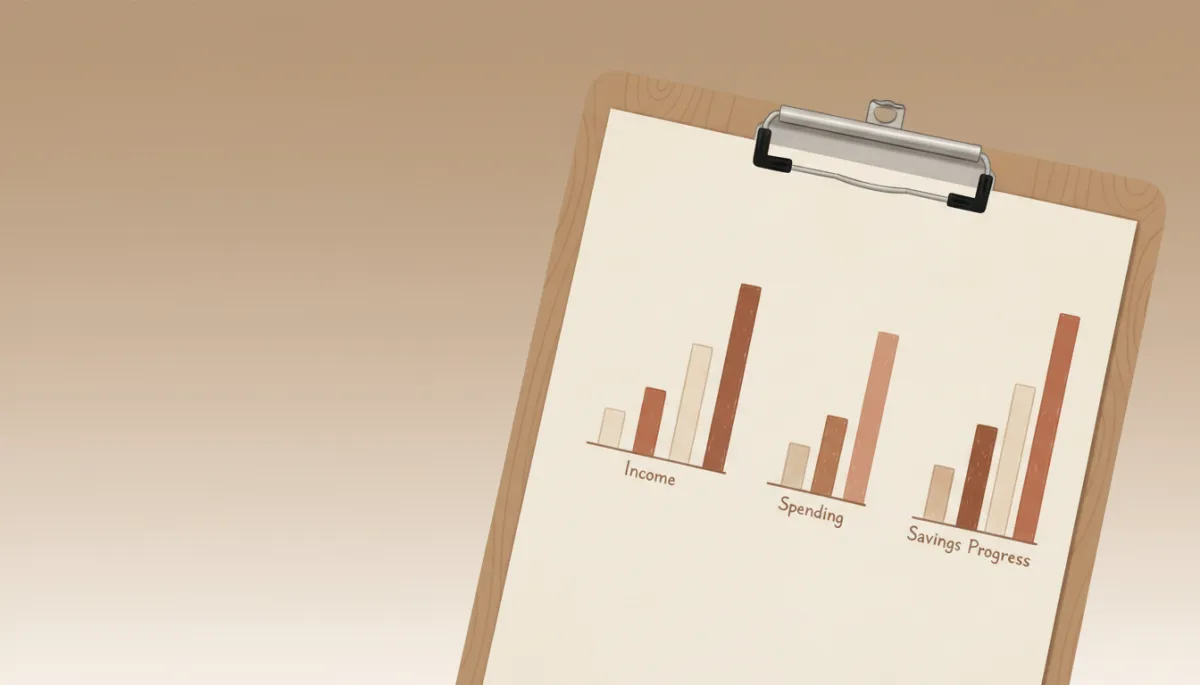
Small monthly improvements compound into meaningful financial change over time.
Building Financial Habits That Actually Stick
The magic of a monthly review isn’t in the numbers themselves. It’s in the habits that form around them. Emma noticed three small financial habits that started to anchor her money management:
She checked her accounts once a week, not obsessively, but with curiosity—like reading the next page of a book she was writing.
She set small, specific targets: “Save $75 this month,” “Pay $40 extra toward the card,” “Cut delivery orders in half.”
She celebrated progress, not perfection—a week without takeout, a month of sticking to her monthly budgeting plan, a small bump in savings.
💡 Pro Tip: Attach your review to an existing ritual—Sunday coffee, the first evening after payday—so it feels like part of your life, not another chore.
Practical Budgeting Tips You Can Steal from Emma’s Story
Emma’s story is just one version of what consistent financial reviews can look like. Yours will have different numbers, different goals, different plot twists. But you can borrow a few of her most effective budgeting tips and adapt them to your own personal finance journey:
Name your goals in plain language. Instead of “general savings,” try “three months of rent saved” or “plane ticket to see Dad.” Clear goals make money management feel personal, not abstract.
Give every dollar a destination. When you do your monthly budgeting, assign each dollar to a category—needs, wants, or goals—before the month begins. The review at the end simply checks whether reality matched the plan.
Highlight one habit to tweak each month. Maybe this month it’s groceries, next month it’s subscriptions. One focused change beats ten vague intentions.
Track feelings, not just figures. In your review, jot down how spending in each category made you feel—rushed, proud, regretful, fulfilled. Over time, this emotional map becomes a powerful guide for your decisions.

Confidence grows each time you keep your monthly money date with yourself.
Your First Monthly Review: A Simple 30-Minute Script
If you’ve never done this before, your first monthly review might feel awkward—like opening a book in the middle and trying to catch up. That’s okay. Here’s a simple 30-minute script to get you started on your own financial reviews habit:
Gather your numbers (5 minutes). Open your banking apps, credit card statements, and any budgeting tools you already use. You don’t need perfection—just enough to see the big picture of your personal finance for the month.
Sort your spending (10 minutes). On paper or in a simple spreadsheet, group your expenses into three buckets: needs, wants, and goals. Notice which bucket feels heavier than you expected.
Reflect and rewrite (10 minutes). Ask yourself: What surprised me? What am I proud of? What one thing do I want to change next month? Write down a short plan for your next round of monthly budgeting.
Set a date for next month (5 minutes). Put your next review on the calendar. Treat it like any other important appointment. This is how financial habits are born—on purpose, not by accident.
The Quiet Power of Paying Attention to Your Money
Six months after that night at her kitchen table, Emma opened her banking app again. The number wasn’t huge, but it felt different: a small emergency fund, a shrinking credit card balance, and no more end-of-month panic. Her life hadn’t turned into a lottery story. She still had bills, still had to say no to some invitations, still had to choose between this or that. But she no longer felt like money was something that just happened to her. Through consistent money management and gentle monthly check-ins, she had stepped into the role of author, not just character, in her financial story.
That’s the real promise of monthly financial reviews. Not instant wealth, not a perfect spreadsheet, but a steady, grounded sense of control. A feeling that you know what your money is doing, where it’s going, and why. Over time, those quiet 30-minute sessions become one of the most powerful financial habits you’ll ever build.
Your story won’t look exactly like Emma’s. Your numbers, your dreams, your challenges are your own. But the habit that changed everything for her—sitting down once a month, looking honestly at the truth, and choosing the next chapter with intention—can change everything for you, too. All it asks is this: one quiet hour, once a month, and the courage to really look at your money and decide what you want it to do for the life you’re building.
Numbers that finally make sense.
Tru-Financial Management gives contractors and small businesses clean books, real job costing, and tax-ready financials — all in one house.
Book a free consultation